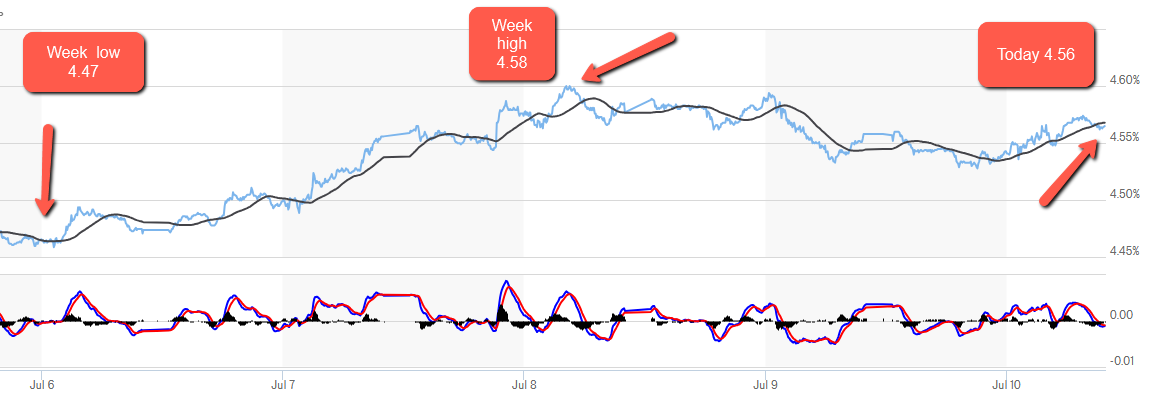
After beginning the week on relatively stable footing, the bond market experienced a noticeable reversal that pushed the 10-year Treasury yield higher by week's end. While there was an early bid for Treasuries following the Independence Day holiday, that strength faded as investors became increasingly concerned about inflation, resilient economic data, and geopolitical risks.
Weekly progression:
- Monday (7/6): The 10-year Treasury traded near 4.46%, benefiting from post-holiday buying and lingering optimism following the previous week's softer employment report. Mortgage-backed securities (MBS) also improved, allowing lenders to offer slightly better pricing.
- Tuesday (7/7): Yields dipped modestly after weaker-than-expected ISM Services data suggested slower economic activity, briefly supporting bonds.
- Wednesday (7/8): The market remained largely range-bound while investors digested FOMC minutes and awaited additional economic data. Treasury auctions produced mixed results, limiting further gains.
- Thursday (7/9): The tone shifted decisively. Stronger labor market data and concerns that inflation may remain persistent pushed Treasury yields sharply higher. The 10-year moved back toward 4.55%, causing mortgage-backed securities to weaken.
- Friday (7/10): Treasuries recovered slightly during morning trading, but only after several days of selling pressure. The 10-year remained elevated around 4.55%-4.57%, roughly 10 basis points higher than where it started the week. Markets were positioning ahead of next week's CPI report while monitoring Middle East tensions and rising energy prices.
How Mortgage Rates Reacted
Mortgage rates followed the Treasury market, although not point-for-point.
Because mortgage rates are primarily driven by mortgage-backed securities rather than the Treasury alone, lenders initially held pricing fairly steady early in the week. However, as Treasury yields climbed Thursday and MBS prices declined, most lenders issued modest reprices for the worse.
Weekly mortgage rate movement:
- Conventional 30-year fixed rates began the week around 6.46%-6.47%.
- By Thursday and Friday, pricing had increased to approximately 6.50%-6.57%, depending on the survey and lender. Freddie Mac's weekly survey rose to 6.49% for the week ending July 9.
What Drove the Move?
Several factors combined to pressure long-term rates:
- Stronger-than-expected labor market data reduced expectations for near-term Fed easing.
- Investors remained concerned that inflation could stay elevated.
- Rising oil prices and renewed geopolitical tensions increased inflation expectations.
- Markets positioned cautiously ahead of next week's Consumer Price Index (CPI), one of the month's most important inflation reports.
Bottom Line
The bond market gave back its early-week gains as investors shifted toward a more cautious outlook on inflation. The 10-year Treasury yield climbed roughly 10 basis points during the week, and mortgage rates responded by edging 3 to 8 basis points higher. While the move wasn't dramatic, it reinforces that markets remain highly sensitive to inflation data and Fed expectations. Next week's CPI report is likely to be the next major catalyst for both Treasury yields and mortgage rates.